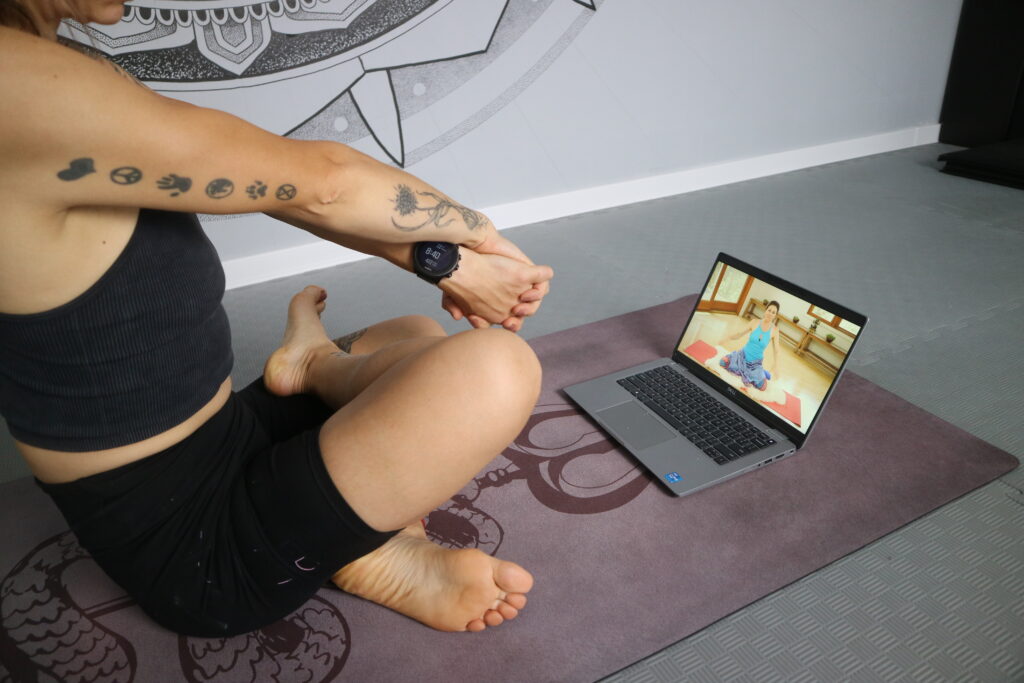
It’s been a few years since the world collectively made a shift to online spaces – thanks, COVID! And while many studios have successfully reopened post-pandemic, this experience has undoubtedly changed the shape of yoga practice.
For many people, online practice remains a more convenient choice, whether it’s following a pre-recorded class or attending a live lesson.
Why People Do Yoga Online
- No need to commute, which saves time, effort, and money.
- Broader access to free or low-budget yoga resources.
- Connect with teachers worldwide.
- Flexibility to fit yoga practice around other commitments and odd work schedules.
- Optimal setting: you’re in control of temperature, props, music, lighting, smells etc.
- Less anxiety associated with social scenarios.

How to Practice Safely
As a yoga instructor who teaches exclusively online (for the moment, at least), my main concern is the safety and effectiveness of my students’ practice. Drawing on my experience from the last few years, I’ve scribbled down the most practical ways to stay safe when you do yoga remotely.
Learn to Listen
When all you have to rely on is your computer or phone screen, you have to rely more heavily on spoken cues. It helps if you’re familiar with the teacher’s delivery style and pose names, too.
Love Your Props
Even if you only have a pair of yoga blocks, you can transform your home practice with props. You can also make use of household objects like blankets, cushions, and towels.
Let Your Body Guide You
Even in-person classes cannot guarantee that the teacher will notice if you’re putting yourself at risk. Part of yoga practice is learning the limitations of your body and adjusting accordingly.
Remember – no one knows your body better than you! When there is no direct line of sight between you and the teacher, it’s best to err on a side of caution to avoid injury.
